 Facebook
 Instagram
 Twitter
 Linkedin

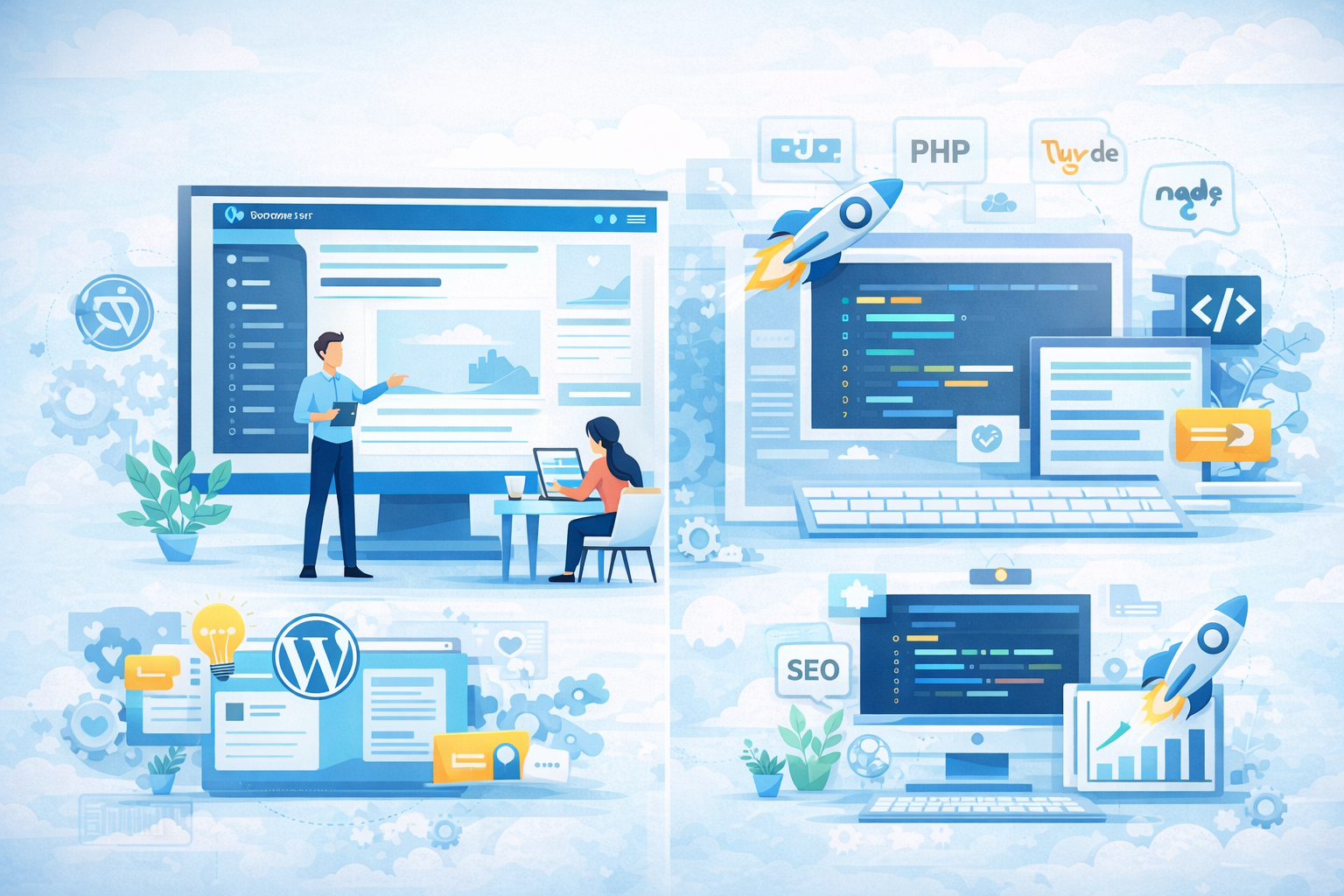
When someone plans to build a website, one common question arises:
Should they use WordPress or build a site using a programming language like PHP, Laravel, Node.js, or Python?
While language-based websites have their place, WordPress continues to be the smarter choice for most businesses,
startups, and content-driven platforms. The reason is not hype—it is practicality, flexibility, and long-term sustainability.
WordPress Solves Real Business Problems, Not Just Technical Ones
A language-based website focuses heavily on how to build something. WordPress focuses on why you are building it.
Most businesses do not want to write code for every small change or depend on developers for basic updates.
They want simplicity, speed, and control—and WordPress delivers exactly that.
Speed of Development Is a Major Advantage
With WordPress, a professional website can go live in days instead of weeks.
Themes and plugins eliminate the need to build everything from scratch.
In contrast, language-based websites require manual development even for basic features,
which increases development time and cost.
Non-Technical Teams Can Manage WordPress Easily
One of WordPress’s biggest strengths is usability.
Content managers, marketers, and business owners can manage the website without touching code.
Language-based websites usually require developer involvement for even minor changes,
creating unnecessary delays and dependency.
WordPress Is Cost-Effective in the Long Run
Although custom-coded websites may appear cleaner initially, they often become expensive over time due to
maintenance, feature upgrades, and bug fixes.
WordPress reduces long-term costs by offering ready-made solutions, affordable hosting,
and a large pool of skilled developers.
SEO and Content Management Are Built In
Search engines favor well-structured and regularly updated content.
WordPress provides SEO-friendly URLs, easy metadata control, and powerful optimization tools.
In language-based websites, SEO must be manually coded and maintained,
making updates more complex and time-consuming.
Security and Updates Are Easier to Handle
WordPress is often criticized for security, but the reality is that a well-maintained WordPress website
is highly secure.
Frequent core updates, security plugins, and a large community ensure that vulnerabilities
are identified and fixed quickly.
Scalability Without Rewriting Everything
WordPress allows websites to start small and scale smoothly.
New features such as eCommerce, memberships, or APIs can be added without rebuilding the site.
Language-based websites often require architectural changes or major refactoring when scaling,
which increases complexity.
Massive Community and Ecosystem
WordPress powers over 40% of the internet, which means unmatched community support,
extensive documentation, and long-term stability.
Many programming frameworks lose popularity over time, but WordPress continues to evolve and remain relevant.
When Language-Based Websites Make Sense
WordPress is not the solution for every project.
Language-based websites are more suitable for complex SaaS platforms,
real-time applications, or highly customized systems.
However, for blogs, corporate websites, eCommerce stores, portfolios, and service-based businesses,
WordPress is usually the better choice.
Final Thought
WordPress is not less professional than custom code—it is simply more practical.
It allows businesses to focus on growth rather than technical maintenance.
WordPress lets you focus on your business, not your code.


 Case studies
 Career